Chinese Ambassador to Botswana Fan Yong Publishes A Signed Article Titled “Leveraging Intelligence to Empower Development: Jointly Creating a New Chapter in China-Botswana Digital Cooperation” in the Botswana Guardian
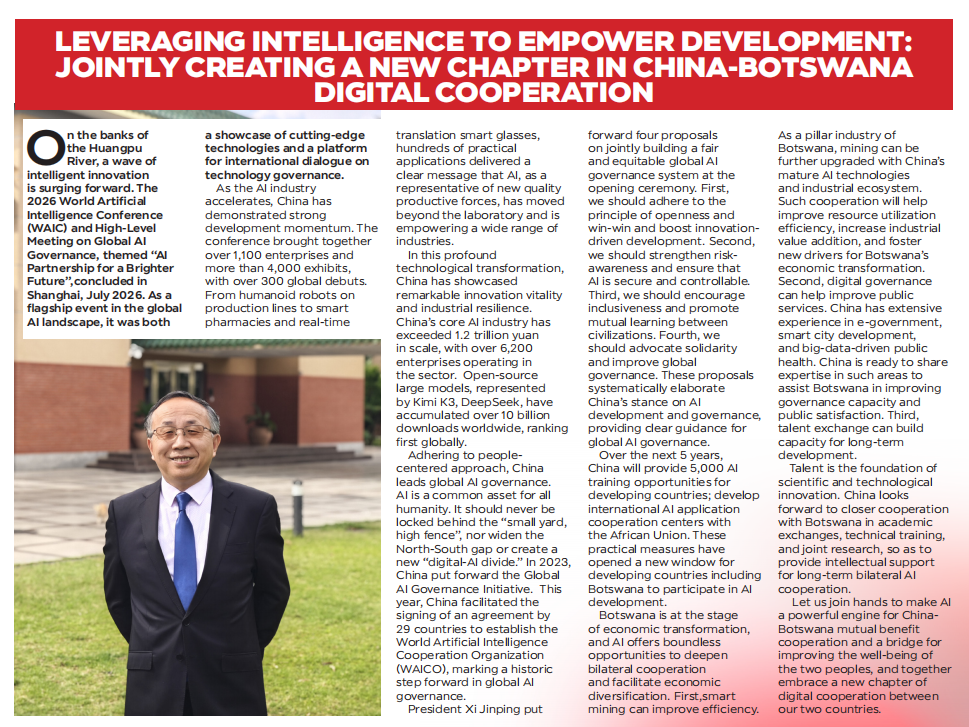
On August 20, 2026, Amb. Fan Yong puts an article titled “Leveraging Intelligence to Empower Development: Jointly Creating a New Chapter in China-Botswana Digital Cooperation” to local newspaper the Botswana Guardian. In the article, Ambassador Fan introduced China’s achievements in artificial intelligence innovation and its propositions on AI governance, highlighting the potential of AI to support Botswana’s economic diversification, improve government governance and cultivate talent, and to advance China-Botswana cooperation in the digital sector to a new level. The full text is as follows:
On the banks of the Huangpu River, a wave of intelligent innovation is surging forward. The 2026 World Artificial Intelligence Conference (WAIC) and High-Level Meeting on Global AI Governance, themed "AI Partnership for a Brighter Future", concluded in Shanghai, July 2026. As a flagship event in the global AI landscape, it was both a showcase of cutting-edge technologies and a platform for international dialogue on technology governance.
As the AI industry accelerates, China has demonstrated strong development momentum. The conference brought together over 1,100 enterprises and more than 4,000 exhibits, with over 300 global debuts. From humanoid robots on production lines to smart pharmacies and real-time translation smart glasses, hundreds of practical applications delivered a clear message that AI, as a representative of new quality productive forces, has moved beyond the laboratory and is empowering a wide range of industries.
In this profound technological transformation, China has showcased remarkable innovation vitality and industrial resilience. China's core AI industry has exceeded 1.2 trillion yuan in scale, with over 6,200 enterprises operating in the sector. Open-source large models, represented by Kimi K3、DeepSeek, have accumulated over 10 billion downloads worldwide, ranking first globally.
Adhering to people-centered approach, China leads global AI governance. AI is a common asset for all humanity. It should never be locked behind the "small yard, high fence", nor widen the North-South gap or create a new "digital-AI divide." In 2023, China put forward the Global AI Governance Initiative. This year, China facilitated the signing of an agreement by 29 countries to establish the World Artificial Intelligence Cooperation Organization (WAICO), marking a historic step forward in global AI governance.
President Xi Jinping put forward four proposals on jointly building a fair and equitable global AI governance system at the opening ceremony. First, we should adhere to the principle of openness and win-win and boost innovation-driven development. Second, we should strengthen risk-awareness and ensure that AI is secure and controllable. Third, we should encourage inclusiveness and promote mutual learning between civilizations. Fourth, we should advocate solidarity and improve global governance. These proposals systematically elaborate China's stance on AI development and governance, providing clear guidance for global AI governance.
Over the next 5 years, China will provide 5,000 AI training opportunities for developing countries; develop international AI application cooperation centers with the African Union. These practical measures have opened a new window for developing countries including Botswana to participate in AI development.
Botswana is at the stage of economic transformation, and AI offers boundless opportunities to deepen bilateral cooperation and facilitate economic diversification. First,smart mining can improve efficiency. As a pillar industry of Botswana, mining can be further upgraded with China's mature AI technologies and industrial ecosystem. Such cooperation will help improve resource utilization efficiency, increase industrial value addition, and foster new drivers for Botswana’s economic transformation. Second, digital governance can help improve public services. China has extensive experience in e-government, smart city development, and big-data-driven public health. China is ready to share expertise in such areas to assist Botswana in improving governance capacity and public satisfaction. Third, talent exchange can build capacity for long-term development. Talent is the foundation of scientific and technological innovation. China looks forward to closer cooperation with Botswana in academic exchanges, technical training, and joint research, so as to provide intellectual support for long-term bilateral AI cooperation.
Let us join hands to make AI a powerful engine for China-Botswana mutual benefit cooperation and a bridge for improving the well-being of the two peoples, and together embrace a new chapter of digital cooperation between our two countries.